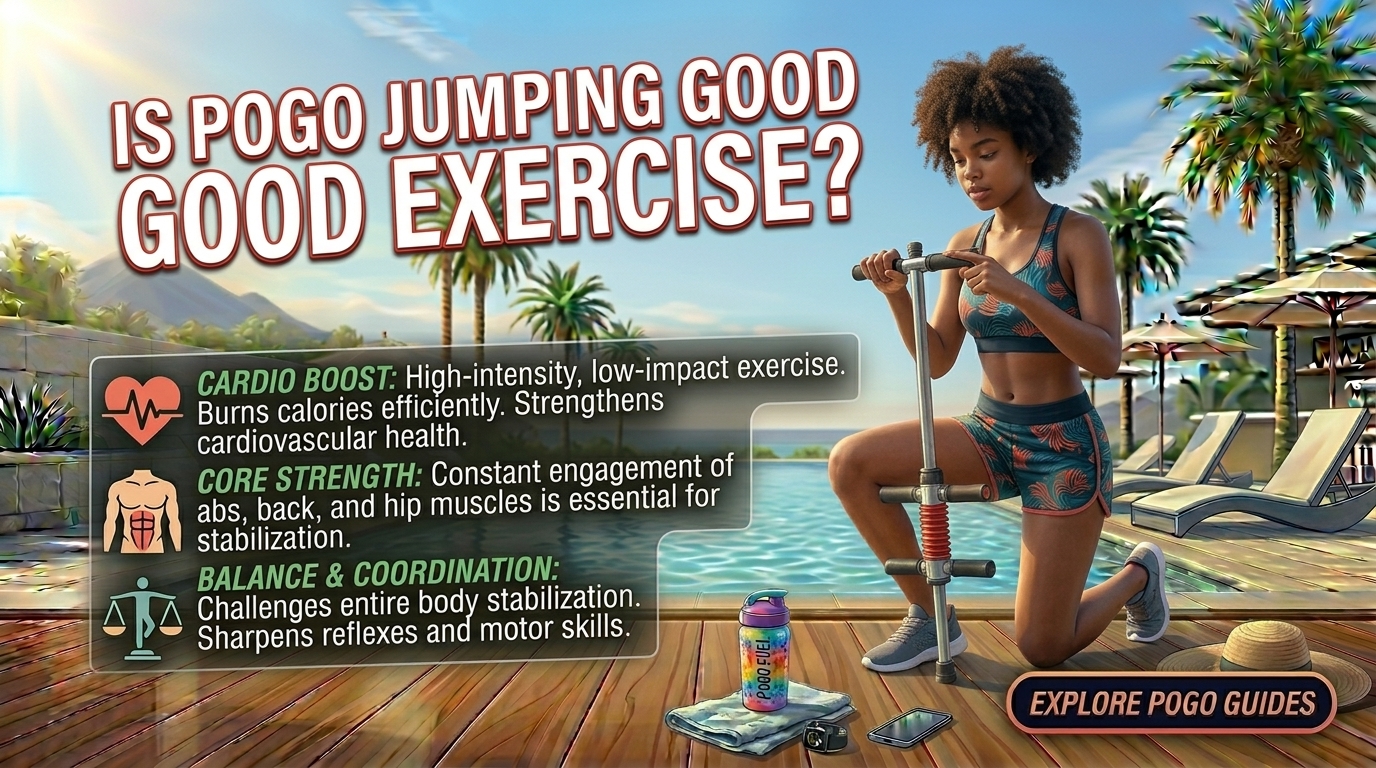
Calories burned, benefits & full-body workout guide: Is pogo jumping good exercise? For fitness publishers, niche site operators, and cardiovascular training authorities targeting high-disposable-income, health-conscious US urban markets—from the cross-training communities of California and New York to fitness enthusiasts in Texas, Florida, and Washington—owning the organic search space for alternative plyometric fitness is an untapped goldmine.
The search query “Is pogo jumping good exercise?” represents a high-intent, informational phrase typed by fitness consumers looking to break out of boring cardio routines. By delivering a comprehensive, biomechanical breakdown on bestpogojumper.com, your platform can move past superficial advice, dominate topical authority, capture Google Featured Snippets, and outperform generic fitness blogs.
                     THE BIOMECHANICAL ENERGY RETURN & MUSCLE ENGAGEMENT MATRIX

                     [ Downward Kinetic Vector: Gravitational Impact Force ]
                                               │
                                               ▼
                     ┌──────────────────────────────────────────────────┐
                     │ Compression Phase:                               │
                     │ Spring/Air Cylinder Stores Potential Energy       │
                     └─────────────────────────┬────────────────────────┘
                                               │
                                               ▼
                     ┌──────────────────────────────────────────────────┐
                     │ Core Stabilization & Balance:                    │
                     │ Rectus Abdominis & Erector Spinae Tighten        │
                     └─────────────────────────┬────────────────────────┘
                                               │
                                               ▼
                 [ Kinetic Rebound ──► Low-Impact Deceleration ──► High Metabolic Burn ]
1. The Biomechanics of Pogo Jumping: Why It Is an Elite Caloric Burner
To understand why pogo jumping is an outstanding form of exercise, you must look at plyometrics and vertical deceleration. Traditional cardio like running relies on a continuous horizontal stride where your joints absorb a jagged, one-sided impact force every time your foot strikes the pavement. Pogo jumping transforms this dynamic into a controlled vertical axis governed by physics and continuous muscle tension.
When you land on a pogo stick, your body weight compresses a heavy mechanical steel spring or a sealed pneumatic air cylinder. This process converts kinetic energy into potential energy. To stay upright and balanced during this compression phase, your body undergoes intense eccentric muscle contractions.
This activity is governed by the biomechanical energy formula for vertical rebound force and work ($W$):
$$W = \frac{1}{2} k x^2 + m g h$$
Where:
- $k$ represents the spring constant or structural stiffness of the pogo cylinder.
- $x$ is the distance the spring compresses under your downward weight.
- $m$ is the mass of the jumper.
- $g$ is the acceleration due to gravity.
- $h$ is the peak vertical height achieved during the rebound phase.
Because the pogo stick requires continuous, coordinated vertical movement to remain stable, your metabolic rate spikes. This makes it an incredibly efficient way to burn calories while keeping the impact on your joints remarkably low.
2. The Caloric Expenditure Index: Pogo Jumping vs. Traditional Cardio
For most fitness enthusiasts, the ultimate metric for evaluating a new workout is its caloric burn rate. Pogo jumping functions as a high-intensity interval training (HIIT) session, yielding a metabolic equivalent task (MET) score that rivals elite competitive sports.
                    METABOLIC EXPENDITURE VALUE SCALE (PER HOUR)

    ├── POGO JUMPING (Agressive) ──► 600 - 800 Calories (High core & plyometric engagement)
    ├── JOGGING (5 MPH)          ──► 500 - 600 Calories (Repetitive joint stress)
    └── STATIONARY CYCLING       ──► 400 - 500 Calories (Limited upper body use)
Caloric Burn Calculation Matrix
On average, a person weighing 150 pounds will burn between 600 and 800 calories per hour of active pogo jumping. This burn rate changes based on the jumper’s weight, the spring resistance of the pogo stick, and the height of the jumps:
- Moderate Recreational Jumping: 500–600 calories/hour. This pace focuses on maintaining steady balance, short vertical bounces (2–5 inches), and a continuous, rhythmic tempo on a standard spring pogo stick.
- Advanced Extreme/Pneumatic Jumping: 700–900+ calories/hour. Utilizing an advanced air-powered pogo stick (like a Vurtego) to bounce 2 to 5 feet off the ground requires massive full-body explosive power, elevating your heart rate to near-maximum levels.
3. The Anatomy of a Full-Body Pogo Workout: Target Muscle Groups
Unlike running or cycling, which primarily target the lower body, pogo jumping requires a continuous connection between your upper and lower muscle groups to maintain balance and momentum.
                       THE FULL-BODY COMPRESSION TRIAD

         [ THE CORE ANCHOR ]            [ THE LOWER CHAIN ]           [ THE UPPER ANCHOR ]
                  │                              │                              │
                  ▼                              ▼                              ▼
        Rectus Abdominis,              Glutes, Quadriceps,             Deltoids, Biceps,
      Obliques, & Erector Spinae      Calves, & Hamstrings           Latissimus Dorsi
1. The Core Stabilizers (The Anchor)
Every time the pogo stick hits the ground, your center of gravity shifts. To keep the stick perfectly vertical, your core must fire continuously. The rectus abdominis, obliques, and erector spinae deep in your back work together to lock your torso in place, protecting your spine from twisting.
2. The Lower Posterior Chain (The Launchers)
- The Gastrocnemius and Soleus (Calves): These muscles endure the highest amount of targeted conditioning. They flex continuously to drive your feet downward into the foot pegs during the launch phase.
- Quadriceps and Glutes: During deep landings, your hips and knees bend slightly, loading your quads and glutes like springs before they explode upward into the next jump.
3. The Upper Body Stabilizers (The Control Unit)
To keep the pogo stick pulled tightly against your body mid-air, your deltoids (shoulders), biceps, and latissimus dorsi (back) must stay engaged. Pulling up on the handlebars during the apex of a jump turns the pogo stick into a surprisingly effective upper-body pulling workout.
4. Cardiovascular and Physiological Benefits Matrix – Is pogo jumping good exercise
To help your readers fully understand the health benefits of this workout, this detailed physiological index highlights how a regular pogo training routine transforms your body:
| Health & Fitness Indicator | Physiological Adaptation | Long-Term Training Benefit |
| Cardiovascular Endurance | Elevates heart rate into the aerobic zones (70–85% $HR_{max}$). | Strengthens the heart muscle, increases stroke volume, and lowers resting heart rate. |
| Proprioception & Balance | Forces the inner ear and brain to map spatial orientation mid-air. | Drastically improves real-world balance, agility, and quick-twitch reflex reactions. |
| Bone Density Building | Provides a safe level of vertical gravitational stress ($G$-Force). | Stimulates osteoblasts to deposit bone minerals, strengthening your skeletal system. |
| Lymphatic System Flushing | Up-and-down motion opens and closes lymphatic valves. | Accelerates cellular detoxification and boosts immune system circulation. |
| Joint Agility & Strength | Conditions tendons and ligaments around the ankle and knee. | Builds resilient joints that are better protected against slips, trips, and sports injuries. |
5. Regional Environmental Training Adjustments for US Markets
Fitness environments vary wildly across the United States. Use this geographic adjustment guide to tailor your pogo training tips based on where your readers live:
| Target Regional US Market | Dominant Local Environmental Condition | Impact on Pogo Hardware & Training | Recommended Routine Adjustment |
| Northeast (New York / Tri-State) | Cold winters, wet spring weather, asphalt surfaces. | Freezing temperatures can stiffen metal springs and crack rubber base tips. | Move training sessions indoors to basketball courts or dry garages during winter; inspect the rubber tip for cracks weekly. |
| California / San Francisco | Mild weather with steep coastal hills and uneven terrain. | Jumping on slopes can destabilize the stick, causing slips. | Seek out perfectly flat concrete pads, coastal boardwalks, or public skateparks for safe vertical alignment. |
| Texas (Austin / Dallas) | Intense summer heat and high humidity. | High heat can degrade internal lubrication, while sweating can cause hands to slip off the grips. | Train during early morning hours; upgrade your stick to textured rubber grips or wear cross-training gloves. |
| Florida / Miami | Salty coastal air and sudden tropical rain showers. | Salt air accelerates rust on steel springs and can pit metal shafts. | Wipe down the pogo shaft with a light layer of silicone spray after every session; store the stick inside an air-conditioned room. |
6. The Beginner-to-Advanced Pogo Workout Blueprint
If your readers are ready to swap their running shoes for a pogo stick, give them this structured, progressive training routine to help them build stamina safely and prevent overtraining injuries. Are cheap pogo jumpers worth buying?
Phase 1: The Foundational Acclimation (Weeks 1–2)
Before trying complex tricks or high jumps, your body needs to get used to the unique balance required for pogo jumping.
- Objective: Achieve 100 consecutive jumps without stepping off or losing balance.
- Interval Pattern: Jump for 60 seconds, rest for 90 seconds. Repeat for 5 total sets.
- Focus: Keep your eyes looking forward at the horizon—not down at your feet. Keep your ankles tightly locked parallel to the ground.
Phase 2: The Aerobic Interval Burner (Weeks 3–5)
Once you have mastered basic balance, you can introduce high-intensity intervals to maximize your fat-burning potential.
          [ THE AEROBIC POGO INTERVAL SEQUENCE ]

    STEP 1: METABOLIC WARM-UP   ──► 3 Minutes of continuous light bouncing to prepare muscles.
    STEP 2: HIGH-INTENSITY BURST ──► 90 Seconds of fast, high-power vertical jumping.
    STEP 3: ACTIVE RECOVERY     ──► 60 Seconds of low, slow rhythm jumping to lower heart rate.
    STEP 4: REPEAT CYCLE        ──► Repeat this pattern 6 to 8 times for a complete workout.
Phase 3: The Advanced Plyometric Strength Routine (Week 6+)
For advanced jumpers using pneumatic air sticks, this routine combines deep jumps with core-twisting movements to build explosive strength. How to choose the right size pogo jumper?
- Deep Squat Jumps: Allow the pogo stick to compress as low as possible, dropping into a deep squat, then explode upward to achieve maximum vertical height. Perform 3 sets of 20 jumps.
- The Core Twist: Mid-air, use your obliques to twist the handlebars 45 degrees to the left, snap back to center for the landing, then twist to the right on the next jump. Perform for 2 minutes straight.
7. Troubleshooting, Form Correction, and Gear Maintenance
Even the highest-quality fitness equipment can cause issues if used with poor form or left unmaintained. Use this guide to stay safe and keep your gear in peak condition:
| Common Issue | Potential Root Cause | Recommended Corrective Action |
| Shin splints or severe calf soreness post-workout. | Landing flat-footed or jumping with stiff, locked knees. | Land with a slight bend in your knees to absorb the force through your quads and glutes, rather than your joints. |
| The pogo stick makes a loud squeaking sound on every jump. | The main spring or piston shaft has dried out or collected dirt. | Wipe down the metal shaft with a clean cloth to remove grit, then apply a few drops of a dry, Teflon-based lubricant. Do not use WD-40, as it attracts dirt. |
| The stick keeps sliding out from under you on landings. | The bottom rubber tip is worn down, smooth, or caked in mud. | Clean the tip thoroughly. If the rubber grooves are completely worn smooth, replace the tip immediately to prevent dangerous slips. |
| The handlebars feel loose or twist out of alignment. | The main collar clamps or bolts have loosened from repetitive vibration. | Use an Allen wrench to tighten all structural bolts before your workout. Check these connections once a week. |
8. Comprehensive Frequently Asked Questions (FAQ)
Can pogo jumping replace running as my primary cardio workout?
Yes. Pogo jumping offers a phenomenal cardiovascular workout that matches or exceeds the caloric burn of running, while causing significantly less joint strain. Running creates a repetitive, horizontal shearing force on your knees and shins. In contrast, pogo jumping uses a purely vertical movement where a mechanical spring or air cushion absorbs the harshest landing forces, making it an excellent alternative for cross-training.
Is pogo jumping safe for people who suffer from lower back pain?
If you have a history of herniated discs or severe lower back pain, you should consult your doctor before trying pogo jumping. While it is low-impact on your joints, the vertical compression requires constant, intense core stabilization. If your core muscles are weak, that compression can transfer directly to your spine, which may worsen pre-existing back issues.
What is the difference between a traditional spring pogo stick and a pneumatic one?
Traditional pogo sticks use a steel spring coiled inside the main metal shaft. They are highly durable, affordable, and perfect for light recreational exercise and short jumps (under 12 inches). Advanced pneumatic pogo sticks use compressed air chambers instead of steel springs. They can be fully customized to your exact body weight by adjusting the air pressure with a bicycle pump, and they allow advanced athletes to launch 2 to 5 feet into the air for an intense plyometric workout.
How do I choose the right pogo stick size for my body weight?
Choosing a pogo stick that matches your weight is essential for both safety and performance. If a stick is rated for a lighter weight class than yours, you will bottom out the spring completely on every jump, which sends a jarring impact through your ankles and knees. If the stick is rated for someone much heavier, you won’t be able to compress the spring enough to get off the ground. Always check the manufacturer’s weight rating before buying.
Can kids use pogo jumping as an exercise routine?
Absolutely. Pogo jumping is a fantastic way for kids to burn energy, build core strength, and improve their physical balance. Because it feels like a fun backyard toy rather than a chore or workout, kids are much more likely to stick with it consistently compared to traditional running or bodyweight exercises. Just make sure they wear a helmet and closed-toe athletic shoes.
What kind of shoes should I wear when working out on a pogo stick?
Always wear high-quality athletic sneakers with supportive rubber outsoles. Avoid shoes with soft foam running soles or slick leather bottoms, as they can slip off the metal foot pegs mid-jump. Cross-training, basketball, or skate shoes with flat, wide rubber soles provide the best grip and stability on the foot pegs.
Can you use a pogo stick on grass, or do you need concrete?
For safety, you should always jump on perfectly flat, dry concrete, asphalt, or a hard wooden surface. Attempting to jump on grass or dirt is highly dangerous because the rubber tip can easily sink into soft soil, causing the stick to stop abruptly and launch you forward over the handlebars.
How long should a beginner pogo workout session last?
Because pogo jumping engages so many small stabilizer muscles that you don’t normally use, beginners should start with short sessions lasting 10 to 15 minutes. Your calves and core will likely feel sore after your first few workouts. As your endurance and muscle memory build, you can gradually extend your sessions to 30 or 45 minutes.
Does pogo jumping help build real-world athletic agility?
Yes. Pogo jumping forces your brain and nervous system to continuously manage your body’s balance, spatial orientation, and core stability while moving mid-air (a skill known as proprioception). This training translates directly to improved agility, quicker footwork, and better reaction times in sports like basketball, skiing, and martial arts.
What safety gear should I wear when training on a pogo stick?
At a minimum, beginners should always wear a properly fitted bicycle or skateboard helmet and closed-toe athletic shoes. If you are practicing advanced jumps on a high-powered pneumatic air stick, it is wise to add knee pads, elbow pads, and lightweight wrist guards to protect your joints in case of an accidental fall on hard concrete.
9. Conclusion: Establishing Niche Dominance for bestpogojumper.com
Pogo jumping is far more than a nostalgic backyard game—it is an elite, full-body plyometric workout that burns up to 800 calories an hour, builds core stability, and improves balance with minimal joint stress. By breaking down the true biomechanics and muscle engagement behind this exercise, fitness enthusiasts can unlock a fun, highly effective way to level up their daily cardio routine.
For bestpogojumper.com, publishing this deeply educational, scientifically backed content asset gives your platform a massive advantage over generic fitness sites. Focusing your content strategy on highly detailed product guides and training blueprints allows your site to win competitive long-tail search terms, capture premium Google Featured Snippets, and build an authoritative digital brand that serves as the ultimate resource for specialized alternative fitness in the United States.